

Built to fly: how three young Charlestonians created their American dream
Updated: Jul 2
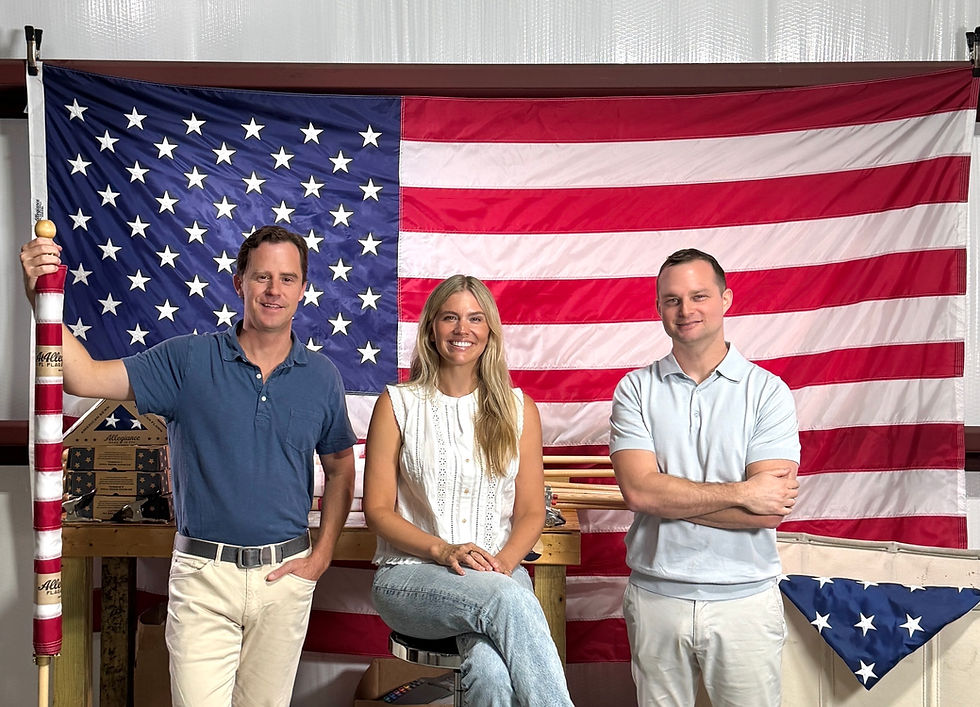
By Patra Ann Taylor
Wes Lyon keeps his phone in his pocket during conversations, which is a small act of courtesy in an age of perpetual distraction. But every so often, mid-sentence, it buzzes. He doesn’t reach for it. He smiles — because he knows exactly what it means: somewhere in America, somebody just bought an Allegiance flag.
He hasn’t turned that notification off, and he doesn’t plan to. “I am kind of paranoid about not wanting to turn those off,” he confesses, “because I am honestly so grateful for each one of them.”
That gratitude is hard-won.
The story of Allegiance Flag Supply begins, as so many great American stories do, with a young man looking skyward. In 2016, Wes Lyon was standing outside his home in the Avondale neighborhood of West Ashley, staring at the flag flying from his front porch. It was tattered. Again. He’d already replaced it a couple of times
“Wes and I had just gotten married,” notes Katie. “We were so excited to fly an American flag. A couple of months later, it started to turn green, to rip and tear. Come to find out, we weren’t savvy enough to look at the tag where it was made.”
It had come from overseas.
“If anything should be made in America,” Wes insisted at the time, “it’s the American flag.” Katie agreed.
That thought, simple as it was, struck a nerve. Wes began researching the American flag market and discovered that imported flags weren’t the exception — they were the rule. At the same time, he and his College of Charleston business school classmate Max Berry had been watching the consumer landscape with entrepreneurial eyes, looking for just the right opportunity to build something of their own. They had even run a couple of small side businesses since graduation. Nothing big, but enough to learn and save.
The missing piece was closer than either of them realized. Katie — Wes’s wife — turned out to be an old middle school friend of Max’s from Mason Preparatory School. When Wes came home from business school one day, he mentioned his new friend named Max Berry. Katie didn’t miss a beat: “I know Max Berry!” Their team had already been assembled. It just took the universe time to catch up.
The three founders began pouring nights and weekends into what would become Allegiance Flag Supply, all while holding down their corporate day jobs. The premise they developed was ambitious in its simplicity: build a genuinely superior American flag — sourced entirely from American materials, sewn by American workers — and market it as a brand of this caliber demands. One of their benchmarks was Yeti.
“Yeti took a product that had been around for a long time,” Wes explains. “They made it better, they made it more rugged, and they marketed it so well that you wanted to put a Yeti bumper sticker on the back of your car. Have you ever seen an Igloo or a Coleman bumper sticker?” That was the standard. DE-commoditize the commodity. Make people proud to own it.
Brilliant.
The first obstacle was figuring out how to make the thing. None of the three had ever sewn a stitch in their lives. Their search for a manufacturer led them, fittingly enough, just across the state line — to a cut-and-sew facility in Vidalia, Georgia called Meredith Industries, run by a man named Tom Meredith.
Meredith Industries had a distinction that caught their attention: It was the second-largest producer of golf course pin flags in the country. Those small, 12x18-inch flags might not look like much, but they take a relentless beating — outdoors 365 days a year, sun, rain, wind and humidity — and they’re engineered accordingly.

Tom Meredith, by Wes’s account, was a genuinely nice man and a patient one. Allegiance wasn’t some big client with a proven track record. They were three earnest young Charlestonians who’d never sewn anything, armed with a conviction and not much else. Meredith agreed to work through the R&D process with them anyway.
What they discovered in that Georgia shop changed everything. The textile technology embedded in a golf course pin flag — developed to withstand daily punishment on the course — had never been applied to a full-size American flag. Wes and his team began transferring those innovations, one by one.
Bar tacks, for instance — those small, reinforced stitches you can find on the belt loops and pockets of your jeans — were strategically placed at the stress points along the fly end of the flag, which is the right side that takes the most wind punishment. The result: stripes that stay intact instead of separating and flapping in opposite directions. Also, the grommet strip on the header was switched to a mold-resistant material, because standard canvas headers turn green and mildewy fast in the Carolina elements. And the fabric itself — first-run 200-denier nylon, known in the textile industry as “elephant hide” — was chosen for the precise balance of durability and lightness. Stiff enough to last. Light enough to fly beautifully in even a gentle breeze.
The three knew they were on the right track, working with established cut-and-sew shops that met their high expectations. In September 2018, they launched their website. Wes describes what happened next in one word: crickets.
The three founders went back to the drawing board to reimage their marketing strategy.
“I always tell people that my mother-in-law, Lissy Morgan, bought the first 40 Allegiance flags,” Wes says with a laugh. “And every time we’d get a sale, I’d look down at my phone and see that it was my mother-in-law again.” Mrs. Morgan was the company’s earliest and most loyal VIP customer — though even her generosity wasn’t enough to make the cash register sing.
Through 2018 and into 2019, Wes worked out of his garage, driving orders down to the USPS location on Sycamore in Avondale. He started as an ordinary customer, dropping packages at the front counter. As volume slowly grew, the staff invited him around back. “I still remember Miss Alice there,” he says warmly. “She was super helpful — a real friend of the business.” It’s the kind of detail only a founder who packed every box himself in the early years would remember.
Then came February 2020. Wes was at a conference in New Orleans for his corporate job when his phone started buzzing in his pocket — and didn’t stop. He stepped out and called Katie and Max. “Is the website broken?” he asked. It wasn’t. Something had clicked. The digital marketing strategy had finally found its audience. Within weeks, flag season arrived, COVID sparked a brief and genuine wave of national unity, and a presidential election year pushed patriotic sentiment further still. Allegiance grew more than 4,000 percent in 2020. That April, all three founders left their corporate jobs and never looked back.
From Wes's garage to a 700-square-foot space rented from Smithy Ironware at the old Naval Yard, to 3,000 square feet on Dorchester Road, then 6,000, then 12,000, then 25,000 — the company has moved four times and currently operates out of a 40,000-square-foot facility in North Charleston, with an eye on eventually buying a 100,000-square-foot building into which to grow.
In October 2021, they brought sewing in-house, training their own team and pulling production back from cut-and-sew shops in Georgia, Florida and Wisconsin. The jobs came home to Charleston. More than 100 of them. Max points out that Allegiance hires veterans and wives of American servicemen.
The flags — five sizes of the 50-star American flag, plus the South Carolina flag, the Texas flag, a USMC flag, the Betsy Ross and the wildly popular Bennington flag commemorating America’s 250th anniversary — are now sewn, start to finish, right here. The Bennington flag, released in limited batches on Friday and Sunday, sells out in 30 minutes.
Allegiance flags are folded in the traditional military triangle and packaged in a handsome presentation box. Customers receive a weekly Sunday email on upcoming dates in American history — a feature so beloved by their customers that families have written in to say they read it together at the dinner table. You can find the flags at showallegiance.com, and locally at Oskar’s Barber Shop in South Windermere and the Preservation Society Shop on King Street, where the story of this Charleston-born company gets told to locals and tourists alike.
“I think we’re in the third inning of a nine-inning game,” Wes says — though he admits people have been calling him on that line for two years. He grins. “The game keeps getting longer, I guess.”
Every time his phone buzzes, he’s reminded why that’s a very good problem to have.


