

Meeting Street Memories The Nathaniel Russell House: 51 Meeting St.

By Peg Eastman
Constructed ca. 1808, 51 Meeting St. is now recognized as one of the nation’s finest examples of Adamesque domestic architecture. It was built by Nathaniel Russell, son of Joseph Russell, a chief justice of Rhode Island. Born in Bristol, Rhode Island, Russell began his career in Charleston as an agent for Providence merchants in 1765. He later established himself as a prominent merchant in his own right. Russell maintained business contacts with New England and European merchants throughout his career. Locally, his business association with another prominent merchant, William Hopton, enhanced his status, as did marrying his daughter, Sarah Hopton. His wife’s family gave him access to the Lowcountry aristocracy, and his brothers-in-law now included the partners of Powell, Hopton & Company, one of the five largest slave trading firms in South Carolina prior to the Revolution.
At the beginning of the Revolution, Russell lent £11,088 to the state government and served in the Charleston militia. In 1780, he was elected to the South Carolina General Assembly, but when the British occupied the town, he sailed to London. Returning in 1783, he managed to avoid the fines levied at other Tories and continued his mercantile activities. He became involved in politics and voted to ratify the federal Constitution in 1788. In addition to serving in the General Assembly, he held numerous responsible positions. By the time he died in 1820, Nathaniel Russell was considered “the prince of Charleston merchants.”
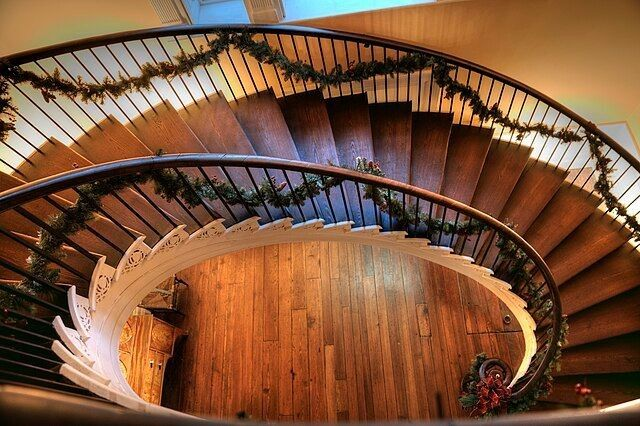
Interestingly, Nathaniel Russell is best remembered today for building one of Charleston’s most treasured architectural gems and one of the most important Adamesque private homes in the United States. The mansion cost $60,000 to complete. Set back from the street, the south side of the house is embellished with a large garden that is meant to be seen from an elevated advantage. To achieve this goal, wrought iron balconies on the second level wrap around the house to showcase the landscaping. The interior free-flying, or cantilever, staircase is considered the most stunning architectural feature in the city.
Adamesque is the American version of a neoclassical style developed by brothers Robert and James Adam, and other British, Irish and European architects of the late 18th century. Influenced by archaeological work that revealed elements of Roman domestic architecture, is sometimes called the Pompeian style. The elegant mansion at 51 Meeting has all characteristics of the style, including an asymmetrical plan with rooms of different sizes and shapes, curving and polygonal forms, contrasting materials and colors, delicate decorations executed in gesso and the iconic curving stair.
The Russells’ social position was assured in 1808 when their elder daughter, Alicia, married Arthur Middleton, grandson and namesake of the signer of the Declaration of Independence. Their younger daughter, Sarah, made an equally opportune marriage to the Right Reverend Theodore Duhon, the second Protestant Episcopal Bishop of South Carolina, succeeding Robert Smith. Dehon was one of the prominent Charlestonians who established The Bible Society, the fifth oldest in the nation. When he died of yellow fever in 1817, widow Sarah Dehon and her three children went back to live at the Russell House, where she helped establish St. Stephen’s Church in 1822 and St. John’s Chapel in 1839, free churches built for people who could not afford a pew. With her two daughters and sister, she founded the Ladies Benevolent Society, ladies who provided basic necessities to the indigent. This was the first visiting nurses’ program in the nation.
When Sarah Hopton Russell died in 1832, her daughter Sarah inherited the house and lived there with her daughter, son-in-law and their 12 children.
In 1857, the house was purchased by Governor Robert Francis Withers Allston, a planter from the Georgetown area. His ancestral home was Chicora Wood. He owned five plantations and at least 690 enslaved Africans, making him one of the largest slaveholders in U.S. history. He married Adeline (Adele) Theresa Petigru, the younger sister of James Lewis Petigru, the well-known Charleston lawyer, who famously exclaimed after the signing of the Articles of Secession, “South Carolina is too small to be a republic and too large to be an insane asylum.” Upon acquiring the Russell House, Allston hired a new gardener, Walter Webb. Receipts indicate that Allston paid Webb for work until 1861. The Allstons were forced to vacate the Russell House during the Union’s 587-day bombardment of Charleston. The house survived intact, and the family returned to their home afterwards. Governor Allston died in 1864, and Mrs. Allston was forced to open her elegant home as a female academy.
In 1870, the Allston executors sold the property to the Sisters of Charity of Our Lady of Mercy, who owned the house for the next 38 years. It was returned to private residential use until it was bought by the Historic Charleston Foundation in 1955. It was open to the public as a house museum and was listed on the National Register of Historic Places in 1971 and designated as a National Historic Landmark in 1974.
In the 1980s, the Foundation commissioned landscape architect Rudy J. Favretti to design a Colonial Revival garden. In the 1990s, the Charleston Museum conducted an archaeological exploration of the landscape, contributing valuable information about the historical use of the yards and changes in the landscape. After the archaeological report was reviewed, it was decided from both monetary and preservation perspectives that restoring a formal garden at the front of the mansion was not feasible.
In late 2023, the public learned that Historic Charleston Foundation planned to sell the Russell House “to focus on future preservation and advocacy efforts.” This news met with tremendous public backlash, with a combination of numerous letters to local newspapers — including this one and its digital cousin — and calls from elected officials, leaders in the preservation community, former colleagues, donors and museum devotees, all desiring to protect the museum. On January 10, 2024, the Historical Charleston Foundation Board of Directors voted to continue to own, operate and care for the Nathaniel Russell House and its collection. Stating on its website: “We plan to collaborate with a panel of experts dedicated to reimagining the museum’s operations and its collection ... to create a vibrant, sustainable future for both the Nathaniel Russell House and the Aiken-Rhett House.” Because of that welcome decision, people continue to enjoy visiting Nathaniel Russell’s magnificent house and admire the luxury of the “prince of merchants.”
My appreciation to Bob Stockton for contributing to this article.
A Charlestonian by birth, Margaret (Peg) Middleton Rivers Eastman is actively involved in the preservation of Charleston’s rich cultural heritage. In addition to being a regular columnist for the Charleston Mercury, she has published through McGraw Hill, The History Press, Evening Post Books and Carologue, a publication of the South Carolina Historical Society. She is a member of the city of Charleston History Commission and serves on the board of the Friends of the Old Exchange.


