

Closing Notes - Where Washington walked and artists lingered
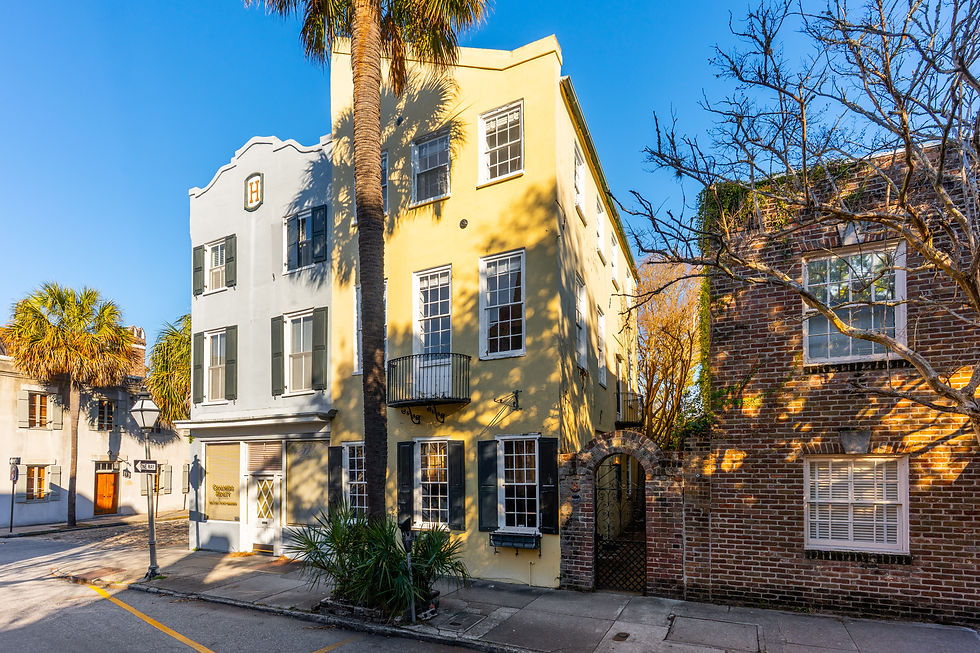
In the spring of 1791, Charleston was in the grip of a kind of civic fever it hadn’t felt before and wouldn’t feel again for a generation. George Washington had come south — and for the better part of a week the city turned itself inside out to receive him: balls at the Exchange, a regatta in the harbor, sermons preached in his honor, streets swept and garlanded for a man Charlestonians had, until then, only read about. His quarters for the visit were located at 87 Church Street, in the handsome home of Thomas Heyward Jr., a signer of the Declaration of Independence. Each morning he would have stepped out onto Church Street itself, into a city still very much under construction, in more ways than one.
It isn’t hard to imagine him passing, a few doors down, a brick house rising out of the sandy Lowcountry soil — masons setting one course after another, mortar curing slowly in the Charleston humidity, a rooftop not yet framed against the sky. That house, built around 1790, still stands today at 124 Church St. Although Washington’s boots probably never crossed its threshold, he was, quite literally, there while it went up — a presence stitched into the earliest days of a house that would go on to hold nearly two and a half centuries of Charleston stories.

Today the address sits in the heart of the French Quarter’s theater district, on a stretch of Church Street just off cobblestone Chalmers, in the shadow of steeples, a few footsteps from gallery windows and restaurant doors propped open to the evening air. The three-story brick masonry home — a contributing structure in the French Quarter Historic District since its listing on the National Register of Historic Places in 1973 — has worn a few different hats over its long life: private residence, carriage house, kitchen house. But its most enduring role may be the one it’s played more recently, as a wellspring for Charleston artists.
Sometime in the mid-20th century, the house served as a painting studio for William Halsey, the influential Charleston modernist whose work still hangs in museums well beyond the Holy City. Then, in 1997, watercolorist Gaye Sanders Fisher bought the pale-yellow house and opened her namesake gallery inside it, where she spent nearly three decades painting the marshes, the light and the architecture of the Lowcountry that surrounds her. It is, in other words, a house with a proven habit of turning residents into artists — or perhaps simply recognizing the artists who found their way to it.
That habit runs deeper still, out through the back door and into its beautiful courtyard. The gallery’s delightful garden shares a wall with the garden of the Pink House on Chalmers Street, once the studio of Alice Ravenel Huger Smith, the celebrated Charleston painter and printmaker whose luminous Lowcountry watercolors helped define how generations of artists — Sanders Fisher among them — have viewed this city ever since. Two houses, two gardens, one shared wall between them: it’s tempting to think of the courtyard less as a boundary than as a passageway, the place where inspiration has quietly flowed from one generation of Charleston artists to the next.

Whoever buys 124 Church St. inherits that same courtyard — and with it, perhaps, that same gift for inspiring whoever spends time there. It’s easy to picture it doing what courtyards do best: morning coffee under the shade, an evening glass of wine after the galleries close, friends gathered around a table while the sound of the neighborhood’s church bells drifts over the garden wall. In a city not exactly short on beautiful outdoor rooms, a courtyard with this particular lineage — one that has hosted two of Charleston’s most beloved watercolorists — is something rarer still: a gathering place with a muse built in.
With 2,652 square feet of living space, the three-story home features three bedrooms, two and a half bathrooms, a spacious dining room, a formal living room and a study. Four lovely fireplaces, exactly where expected, help capture the historic charm of a bygone era.
And then there’s the address itself, which does plenty of work on its own. Few pockets of Charleston offer a more complete life within a five-minute walk. Restaurants, churches, theaters and gallery row are all practically at the front stoop; the Battery and the harbor are an easy stroll south, and the shops and sidewalk cafés of the Market and Upper King aren’t far north. For a buyer drawn to the idea of stepping outside and simply being in Charleston — no car required — it’s hard to imagine a more complete setting than the French Quarter block where Washington once walked. With some tender loving care, this home will once again be fit for a king … or a U.S. president.
124 Church St. is currently offered through Daniel Ravenel Sotheby’s International Realty. Whether the next owners arrive with paintbrushes in hand or simply an appreciation for a house that has quietly kept such good company, they’ll add their own chapter to a story that began with a president’s visit and has been shaped by artists ever since.


