

English Calhoun gets her tarpon
By Ford Walpole

On a recent tarpon-fishing trip with her husband Trent, my daughter English Calhoun wanted to target spottail bass instead of tarpon. Although Trent has had recent success, every time the couple tried for tarpon together, it was always a slow day. She thought she was likely to see more action pursuing spottails; nonetheless, on Labor Day weekend, English Calhoun ultimately agreed to spend a day focusing on the trophy fish.
“Before this day, I had been tarpon fishing about five times, and I had never even seen a fish. But then, any time I would decide not to go, Trent and his friends always caught tarpon,” English Calhoun says.
Last year, Trent began logging his tarpon fishing experiences, being sure to note the tides, time, moon, current and bait. “This year, I started to get really serious about tarpon fishing,” he says. This summer, he fished a couple of tarpon tournaments. In the First Annual Carolina Yacht Club Tarpon Tournament, he and friends hooked a tarpon, but the fish threw the hook — as they are known to do. After landing three fish, he placed third in the Holy City Tarpon Tournament, sponsored by Marsh Wear Clothing.
In the area north of Charleston where Trent fishes, “the prime window is two hours before high tide,” he says. “I like to fish the point of a sandbar where a channel runs through. On that point, the clean water pushes through, and you can see a lot of bait and tarpon. Tarpon are scavengers, and they can easily pick up a lot to eat at that location, which is about 10 feet deep during the tide we are fishing.”
On this occasion, bait was hard to come by. Trent likes to fish with large menhaden and mullet. The weather was sunny, and the water was calm, but he could not locate any menhaden. “When bait is not prevalent, I run off the beach and ride around until I see either pelicans or menhaden flicking around,” he says. “I checked all of my menhaden spots but still could not find any, and we were short on time. So, I went back to the fishing hole where I usually see mullet, and I caught about 50 in the eight-foot cast net. For tarpon, I prefer mullet that are 10 to 12 inches long.
“I like to anchor when I am fishing for tarpon,” Trent explains. “It keeps you more streamlined and in line with the current. I know I am not going anywhere, and it is a stealthier approach than using a trolling motor. I let out almost all of my anchor line. That way, I can hook my Poly Ball to the line, so I don’t need to worry about running into anything; if a tarpon is taking line, and I can’t stop him, I can pull the buoy and leave the anchor.”
Trent typically works four rods when fishing for tarpon. Two have Bulls Bay corks, which are big and easy to see; one cork is short and the other is far. The other rods include a Carolina rig or a sinker-slider rig on the bottom. He likes Eagle Claw Trokar 7/0 hooks with a 60 to 80-pound fluorocarbon leader.
Trent credits Captain J.R. Waits of Fish Call Charters with teaching him about tackle and ideal fishing conditions. “I knew that J.R. was the man for tarpon, so I reached out to him a couple of years ago, and he really shared a lot of his knowledge with me. He told me that when the tide is coming in, you want to look for that line between the brown water and the clean, green water coming in from offshore. Captain J.R. said, ‘When green meets brown, it means silver,’ referring, of course, to tarpon.
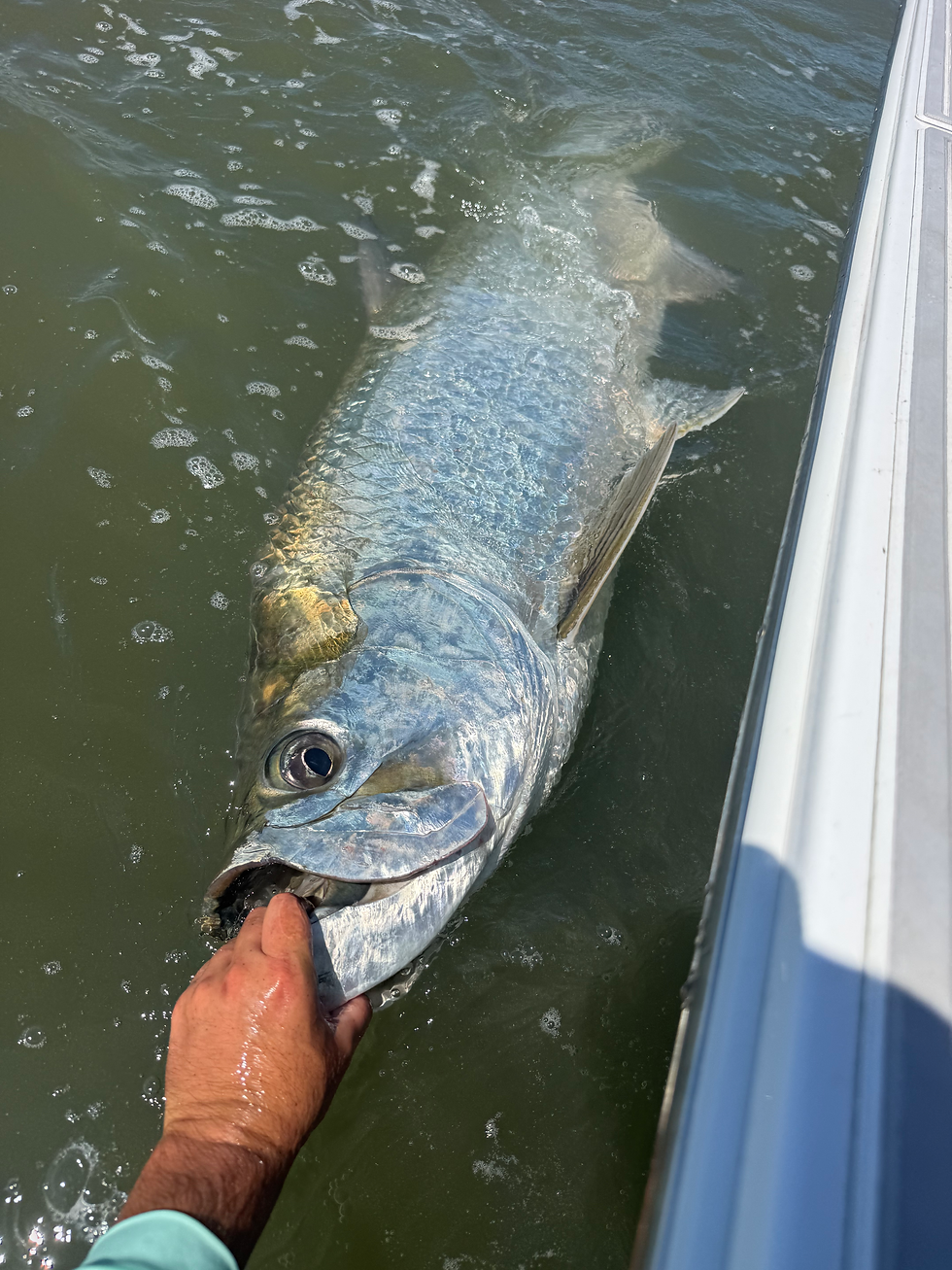
English Calhoun recalls the experience. “We had a couple of earlier bites, and after about 15 minutes, we watched the rod go down. Trent grabbed it, and when we saw the fish jump, we both yelled ‘tarpon’! He then handed me the rod. We had a brief back-and-forth because I was not sure I could do it, but he said, ‘You have to!’ The fish kept jumping, and eventually, at one point, it jumped in front of the boat. We got him up to the boat several times, and he would jump or shake and then swim back out,” she says. Fortunately, the fish stayed behind the boat and away from the anchor line, so they did not need the buoy.
“This happened about five times,” Trent says. “English Calhoun would reel him in, and then he would see the boat. In the process, he would come up and gulp air, and swim back out.”
“Each time, I had to fight the tarpon again, and we were trying to get him up to the boat so we could grab his face and release him,” English Calhoun says. “Initially, it took me about 25 minutes to get the fish to the boat, and each time he swam back out, I had to reel for a few minutes to bring him back. Trent had the leader in his hands, ready to release the tarpon, and his fingers were cut from handling the line without gloves. Finally, he grabbed the fish by the mouth to unhook it while the rod was still in my hand. I held the fish for the picture, and that was a little scary, but I did it!” she says.
Trent sent photos to several taxidermists who specialize in tarpon mounts, and they all confirm that the fish was at least 72 inches. Trent estimates the tarpon to weigh close to 100 pounds. From the photo, he is having King Sailfish Mounts in Fort Lauderdale make a replica mount. They will study the fish’s characteristics and recreate them in the mount.
“The tarpon was hooked perfectly — in the corner of the mouth,” Trent notes. “He jumped so many times that I was concerned he was going to throw the hook before we landed him. Once he was hooked, he immediately jumped three times and another four or five times during the fight. After I pulled out the hook, we kept him alongside the boat for a while to revive him. I swam him in place so that he could regain his energy before we released him.”
English Calhoun discusses the thrill of landing the fine tarpon: “I would say that I probably called as many people to tell them about the fish as I did when we got engaged!” she says. “The experience was so cool because it was just the two of us fishing together, and it was such a special moment because I know how much Trent cares about tarpon fishing.
“I also realize how difficult tarpon are to catch, and after doing it all myself, I was very proud!” she adds. “Now, I clearly understand the obsession with tarpon fishing. Next summer, I plan to go after tarpon a lot more often. Because this was my first one, Trent wanted to get it mounted — even though I hope to catch a bigger tarpon next time!”


