

Technology acceleration: geostrategic confusion
- Apr 10
- 5 min read
Updated: Apr 15
By John C. Wohlstetter

An Air Force B-1B Lancer receives fuel from a KC-135 Stratotanker while on a nighttime mission as part of Operation Epic Fury in the U.S. Central Command area of responsibility.
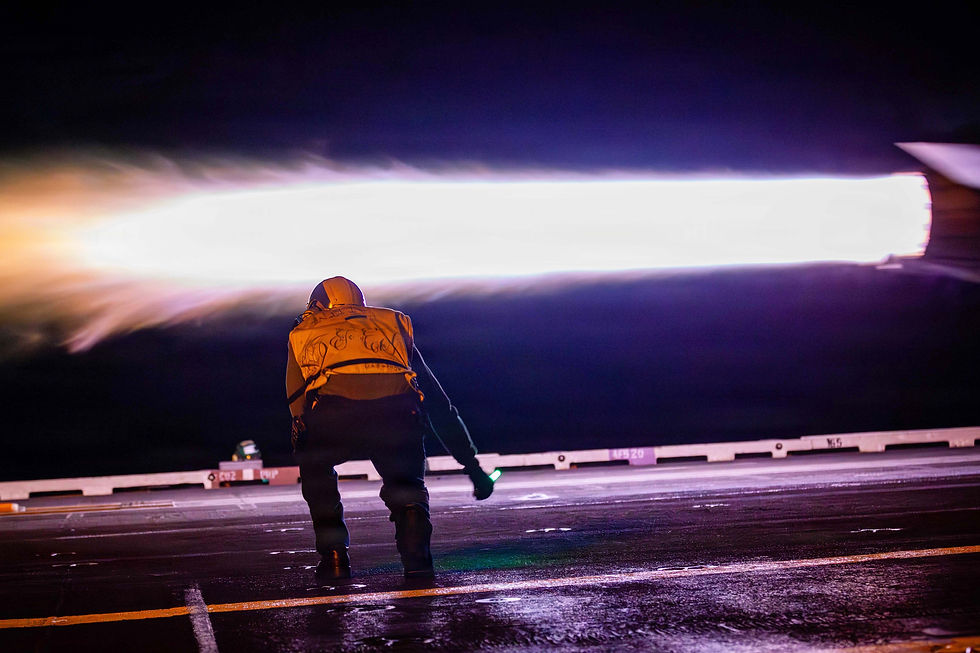
Igniting the Dark: A sailor signals the launch of an f/A-18F Super Hornet aircraft on the flight deck of the USS Gerald R. Ford during Operation Epic Fury in the U.S. Central Command area of responsibility.
Much has been reported about the pivotal role of new technologies during Operation Epic Fury. Clearly, video clips of pinpoint warheads and bomb impacts, interceptions of incoming ballistic missiles, and sinking ships attest to the crucial role technology — largely, but not exclusively, that of the U.S. and Israel — is playing in determining the course of this war. History offers cautionary examples for those who conclude that technological superiority will provide an equally decisive advantage in future conflicts.
World War I (1914-1918)
A brief historical survey of the impact of key technologies in major conflicts from World War I to the present shows considerable variation. The Great War is often cited for the emergence of modern artillery and the machine gun, which proved decisive in the trench warfare that created a sanguinary stalemate. Yet perhaps the greatest overall technology factor was that the technologies of destruction escaped the technologies of command and control. Once the troop trains departed from the embarkation station, they could not be recalled; once a battle started, those on the battlefield frontline could not communicate in real-time with commanders behind the front lines.
World War II (1939-1945)
The most destructive war in history saw countless innovations, in what British wartime prime minister Winston Churchill called the “Wizard War.” Early-generation radar — Radio Direction and Ranging — tracked incoming aircraft on primitive screens during the 1940 Battle of Britain and the eight-month Blitz that followed, without which only planes detected by the naked eye could trigger interceptions, far too late. (An interesting nugget: Early during the conflict, observers noted that female operators were far better at interpreting the oscilloscope screen, paying more patient attention to detail; in short order, all screen operators were women.)
Cracking the German Enigma and Japanese “Magic” ciphers led to many battlefield successes. Thus, Enigma intercepts informed Field Marshal Bernard Montgomery that the supply ship carrying petrol for Field Marshal Erwin Rommel’s army had been sunk. Thus, Montgomery could line up his forces knowing that Rommel’s ability to fight a war of maneuver, equaled on the Allied side only by General George Patton, was neutered. The Nazi advance towards Egypt was stopped at El Alamein on November 8, 1942. Conversely, the failure of American commanders to pass on the intercepted code for a Japanese attack on Pearl Harbor, “east wind, rain,” led to the debacle of Pearl Harbor on December 7, 1941. The message was stove piped (not shared with key commanders) and interpreted the code as indicating that, at most, an attack would be on nearby airfields on the island of Oahu.
The ultimate technology race during the war, in both the Atlantic and Pacific theaters, was for the ultimate weapon, the atom bomb. Fortunately, the Allies won, with Germany and Japan not even close.
Korean War (1950-1953)
Technology proved inconclusive in Korea. General MacArthur wanted to use the atom bomb after China intervened, but likely Mao Zedong would not have given up; we had so few atom bombs. Mao’s China, as did Stalin’s Soviet Union, had such a high tolerance for casualties that dropping atom bombs would not have proved decisive.
Vietnam War (1962-1973)
America’s first 20th-century defeat was fought with mostly mature technologies. First-generation laser-guided, air-launched smart weapons were used to destroy a key bridge, called “The Dragon’s Jaw,” on May 13, 1972. Opened in 1964, between April 3, 1965, and the beginning of 1972, the Air Force had conducted 871 sorties and lost 11 planes; the bridge was destroyed by F4- fighter jets dropping bombs. They scored 24 direct hits.
Gulf War (1990-1991)
Technology took center stage in the operation to eject Iraqi dictator Saddam Hussein’s troops from Kuwait. The “Revolution in Military Affairs” — RMA —s aw ubiquitous use of laser-guided smart munitions, including shells fired by main battle tank guns. Cruise missiles, using TERCOM (Terrain Contour-Marching) guidance, were deadly accurate at first, but as many landmark structures TERCOM used were destroyed, accuracy deteriorated as the war progressed. Alas, defeat was snatched from the jaws of victory when the allies allowed Saddam to survive.
Wars on Terror (2001-2021)
Both Afghanistan (2001-2021) and Iraq (2003-2009) saw the effectiveness of technology blunted by strategic incoherence. Facing asymmetric warfare by terrorists, and given serial adjustment of tactics, our soldiers became targets for IDEs (Improvised Explosive Devices) and the even more lethal EFPs (Explosively Formed Penetrators).
Iran Wars (2025-2026)
The Twelve-Day War last June and the ongoing 2026 war with Iran have seen U.S. and Israeli technologies attain a new accuracy apogee, with many warheads and bombs either landing with pinpoint accuracy or missing by a few feet. In World War II, misses of a mile were not unusual. Cyberwar initially was instrumental in blinding Iran at the outset, with 96 percent of Internet connectivity severed. This fragmentation of command, communication, control and intelligence isolated individual commanders, preventing them from coordinating decisions with others. Commanders proceeded to direct their fire mostly at Arab countries whose leaders had planned to sit out the conflict. Instead, they joined Israel and the U.S.
However, the tables were turned when it came to social media. Social media has exploded in the past five years, with billions now online. Three malignant accelerants have made social media an asset for Iran. Accelerant one is the speed of message distribution. Mark Twain once quipped: “A lie can travel halfway around the world before the truth gets its boots on.” In 2026, lies travel at the speed of light — seven and a half times around the world each second. So, it took the Israelis two months of laborious identification to tally the exact number of killed, wounded and taken hostage. Light travels one trillion miles in two months. Accelerant two is the breadth of message distribution, billions of users on worldwide interconnected networks. Accelerant three is the “80-20 rule” of Pareto distribution, named after the Italian economist Vilfredo Pareto (1848-1923). Originally applied to large industrial enterprises, in today’s networks, it means that 20 percent of users account for 80 percent of traffic volume. Indeed, some major networks are even more skewed: TikTok reports that its top 25 percent account for 98 percent of traffic, and X reports that its top 20 percent account for 97 percent of volume. Sadly, these are mostly activists whose views are more extreme than those of most users.
The bad news arising from this online mismatch is that falsehoods will win the battle, because finding out the truth is always time-consuming. The good news is that if the U.S. and Israel win the wars, most voters will likely view the outcome favorably.
Bottom line
Technological edges do not automatically translate into battlefield supremacy. Unsound strategy and tactics can nullify advantages that superior technology might otherwise offer.
John C. Wohlstetter is a senior fellow at the Seattle-based Discovery Institute and the Washington, D.C.-based Gold Institute for International Strategy. He is the author of Presidential Succession: Constitution, Congress and National Security (3rd ed., 2026), to be published later this year.


