

Robert Hill of Plantersville: a family tradition of gun making and gunsmithing
By Ford Walpole
When you ask Mark Alan at Rivers & Glen Trading Co. to recommend a good Lowcountry gunsmith, he immediately suggests Robert Hill of Plantersville, north of Georgetown. “Honestly, I just love the historic aspect of Robert having been taught by his father and grandfather,” Alan says. “He is a very skilled gunsmith, and he has a wealth of knowledge!”
Robert and his family have deep roots around Georgetown. Their ancestor, Francis Avant, was a Frenchman who received a King’s Grant in the Black River area in 1709, and people with the Hill surname migrated down from coastal North Carolina.
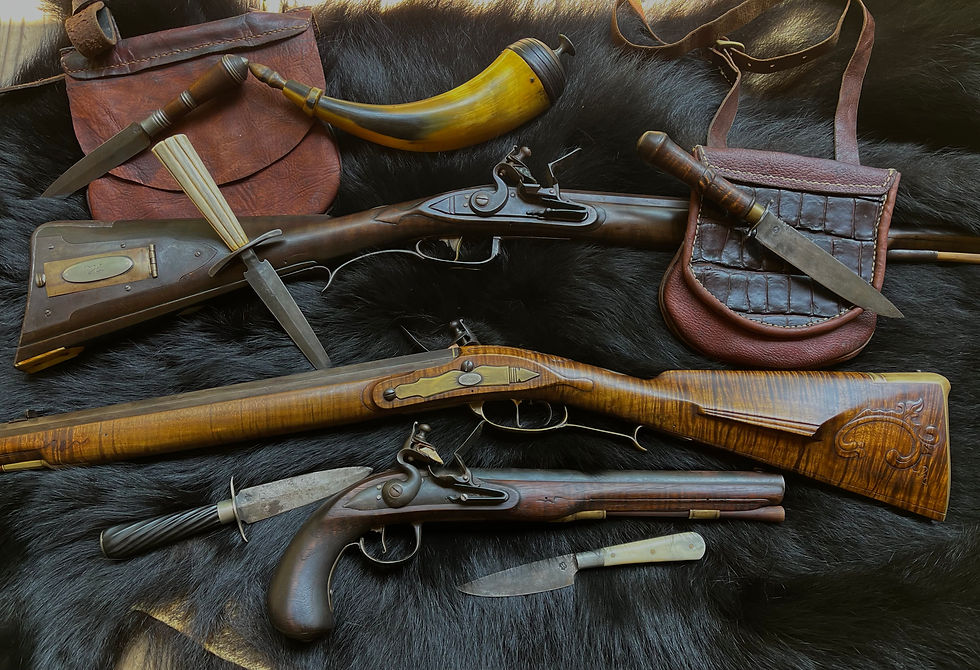
As a boy, Robert Walter Hill V had his own bench in his grandfather’s gunsmith shop, a converted 19th-century tobacco barn. The farmhouse has stood for a century longer than the barn on a place their family has owned for several generations. Bob Hill, Robert’s grandfather, retired from International Paper and, in the 1980s, began making guns in his spare time. “By the time I was 10, I was doing forge work and making powder horns and knives,” Robert says. “During COVID, when I didn’t have to attend school all day, I began working full-time in the shop. Gradually, I became confident enough to go out on my own with projects,” says Hill, who will soon celebrate his 24th birthday.
As a teenager, Walter Hill, Robert’s father, worked as a blacksmith before becoming director of the Horry County Museum in Conway. Walter even spent time with Charleston’s master blacksmith Philip Simmons. Today, you will often find three generations of Hills working side by side in the shop. Robert helps his father fashion wrought-iron gates for private residences as well as a recent addition to Brookgreen Gardens.
As for guns, the Hills specialize in building American long rifles: both flintlock and percussion muzzleloaders. Some states, such as Pennsylvania, have a separate deer-hunting season specifically for flintlock guns. The Hills showcase their wares at several shows throughout the year: the Tennessee Kentucky Rifle Show in Knoxville, the Contemporary Longrifle Association (CLA) Show in Lexington, Ky. and the North Carolina State Fair in Raleigh. Sharon Hill, Robert’s grandmother, accompanies the family to Raleigh to market her own hand-crafted pewter figures and jewelry. “With the rifles, we complete all of the accouterment work, as well; this includes powder horns, leather bags and slings, powder measures, brushes, vent picks, and so forth,” Robert says.

The family recently returned from the 11-day North Carolina Fair, which they have attended for the last 31 years. Robert tagged along as a boy, and he and Bob now serve as the gunmakers for the Village of Yesteryear. “In those early years, Papa would give me good tools to provide me with early tool control, or the proper use of hand tools. I just acquired the skills at an early age, and at the fair, I stayed occupied — whether that was play-carving or scraping on a horn. At the fair, we still use the same workbench from when I was a little boy,” Robert recalls.
Bob Hill was entirely self-taught, and his grandson likewise completed a more practical education. “Growing up, instead of going off to formal gunsmith school, I served a traditional apprenticeship, more in line with a formal European apprenticeship,” Robert notes. “I gained a lot of information from other master craftsmen in the muzzleloader world, but I learned the most from the one I work with every day — my own grandfather!”
For his formal education, Robert graduated from Georgetown High School and earned a degree in anthropology and geography from nearby Coastal Carolina. “That was a fitting major since it is exactly what we are doing with guns,” he explains. “We are conducting experimental anthropology by using past tools and past methods to discover how people in the 18th century were building guns. We have a focus not only on preserving but also teaching these crafts so that people will have an understanding of historic firearms and cultural preservation. For example, at the North Carolina State Fair, I talked to well over 10,000 people a day,” he says. In all, almost one million people travel to Raleigh for the event.
“We are a family affair!” Robert declares. “All of the crafts we are involved in stem from my grandfather’s skills or something we all learned together. In 2021, my grandfather was awarded the Jean Laney Harris Folk Heritage Award by the South Carolina General Assembly. While there are several awards for folk artists, Papa has actually passed on what he knows to multiple generations of artists, which is why he earned this award for being a folk arts advocate.” Bob Hill is also a decoy and figure carver, and he has taught classes at several art shows, including the Fine Arts Festival of Rockingham County and Horry-Georgetown Technical College.
“I guess you could say I am one of the rising stars in the muzzleloader world,” Robert continues. “I have had a few guns photographed for an upcoming article in Muzzleloader Magazine, and I have been on the cover a couple of different times.” In addition, Hill was the youngest person ever to build a rifle for the CLA Fundraising Auction in Kentucky. “We build a lot of muzzleloaders for people to deer hunt with. You can find my guns up and down the East Coast, as far west as Washington and Oregon, and all across the country in between,” Robert says.
Besides making rifles, Robert also engages in custom gunsmithing. With a hammer and chisel, he does a great deal of hand-engraving on guns. He also performs rust-bluing and traditional English, hand-rubbed oil finishes. “We do color case hardening to get blues and straw yellows like you see on the actions of higher-end shotguns,” he adds. In addition, he and his father install toe ovals and also complete hand-checkering, both recutting old and cutting new.
“On the more modern side, we started doing work on reshaping stocks,” Robert says. “Most commercial guns have way more wood than is necessary. We are still drawing from those traditional English and European lines, so we like to trim down the stocks a little bit, like turn-of-the-century Rigby and Mauser Sporting Rifles. We do the same work to guns like Winchester Model 70s and Remington 700s. In addition, we will make a stock with a pancake cheek piece as seen on fine rifles of the past,” Hill adds.
Not only do the Hills pride themselves on building and refinishing beautiful guns, but they also enjoy wielding firearms in the field. They spend a lot of time deer hunting in the Lowcountry, and they hunt with their muzzleloaders when the deer are moving during daylight hours. When they are available, Robert and Walter also serve as part-time weekend bird guides at Backwoods Quail Club. While Robert is away at the North Carolina State Fair, South Carolina’s 40 bear tags for Game Zone 4 are usually filled. This year, since unfilled tags remained, Robert was able to go bear hunting the day he returned home; though he did see several bears, unfortunately, none were suitable for harvest.
As aging proprietors close their small, local gun shops, hunters and gun enthusiasts must visit high-end retailers or big-box stores, depending on their needs, and often hunt for skilled gunsmiths, who tend to work out of garages or home shops. The nearest gunsmithing school is Montgomery Community College in North Carolina.
Nonetheless, “gunsmithing and gun making have experienced a turnaround lately, especially with YouTube and gun shows,” Robert points out. “We have a lot of people who are learning the trade. But from a traditional fine firearm specialist point of view, a lot of people are working on AR-style rifles but are not experienced with traditional guns.
“While gun culture is being preserved,” Hill says, “you do not see a lot of people doing hand engraving or fine metalwork, such as color case hardening. You see a lot of artistic parts of gun making and gun building. Because of that, we try to bring what we do to the public eye. I hold a lot of demonstrations on carving and engraving. We like to show these skills so people have an understanding of wood-stocked guns and realize that not everything is black guns,” he says.
“So much of this kind of business depends on word-of-mouth exposure,” Robert notes. “I get a lot of referrals from Rivers & Glen or people seeing us at a show, so I stay pretty busy,” he says. Hill spends most of his time building custom guns and focusing on custom gunsmithing tasks. He can likely fit your specific requests into his schedule; if not, he recommends Darlington Gunworks for more routine gunsmithing services. Check out some of the Hill family’s creations on Instagram @hillandhill_forge. To obtain Robert Hill’s master services for your own cherished firearms, reach out to him at hillwrobertv@gmail.com or (843) 344-6082.


